
We Think in Markets, Not Just in Products
Why your position in the market matters more than the product itself — reflections from a guest lecture at the HWZ, with M8, TouchWood and DinBrudi as examples.
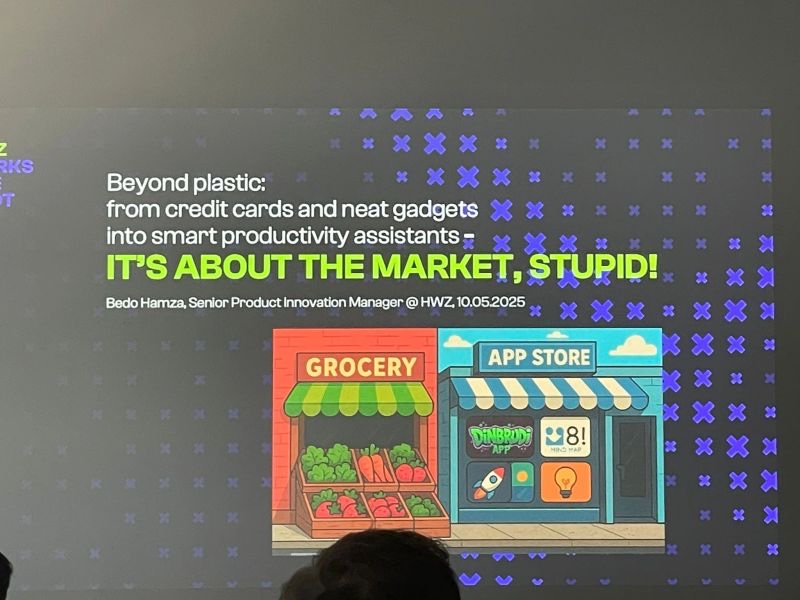
In product development, we start by asking an uncomfortable question. Not “Is the product good?”, but “Is the market right?”. Because a strong product alone rarely decides success or failure — your position in the market does.
I shared this stance in a guest lecture at the HWZ (Hochschule für Wirtschaft Zürich) in the pioneer programme “AI in Finance” (with Patrick Comboeuf). Here’s the core idea, in a bit more detail.
The Rule of Four
Markets tend to consolidate around a few players — as a rule of thumb, roughly four serious participants. The reason: once a market is established, differentiating through the product becomes hard. The offerings converge, and competition shifts away from the product.
The entirely analogue vegetable market offers a vivid picture. If it’s big enough, you’ll often find around four vendors there. They spread out by location and split the market roughly into quarters — each holding about 25 %. They barely compete on price; a price level settles in at which everyone survives. Only as the market matures does it consolidate further. But: whoever holds a share of 20–25 % has a high chance of survival.
Existing Market: 10× Better — or Not at All
From this follows the first point: anyone who is not among the first movers of an existing market has to differentiate strongly through the product. The common benchmark is 10× better — realistically often five to seven times. What matters is being so clearly better that the product spreads through word of mouth.
Why does this matter so much? Without that pull, customer acquisition costs become very high — and that comes directly at the expense of margin. A product that is only “somewhat better” has to buy its way into the market at a high price.
New Market: The First-Mover Advantage
That’s why the big opportunity for startups and new products lies in the new market — where there are no established four yet.
That’s exactly what M8! Mind Map demonstrated. We built the app early for the Microsoft Store and were among the very first mindmapping applications at all. The market wasn’t big — and it still isn’t to this day. But as a first mover, combined with storytelling, marketing and media coverage, we earned ourselves a market leader position: anyone searching the Store for a mindmapping app reliably found us among the Top 4. That position carried the product for a very long time — to over 500,000 downloads.
The Same Pattern, Different Markets
- TouchWood Card — the world’s first payment card made of wood, with no plastic core. A new market, a clear first position.
- DinBrudi — the first to-do app that understands Swiss German. The same principle; the big breakthrough is still ahead here, but the logic stays the same.
Three completely different products — connected by the same sequence: first understand the market, then build.